


 English
 ภาษาไทย
 Русский
 한국어
한국어 にっぽん
にっぽん
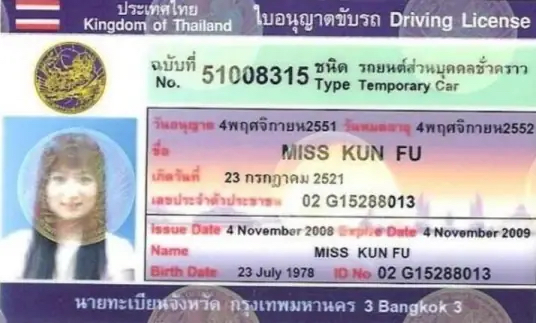
A Thai driver’s license is a legally recognized certificate of driving competency issued by the Department of Land Transport of Thailand. It is valid within Thailand and throughout the ASEAN member states. License holders may apply for an International Driving Permit or, in certain countries, exchange their Thai license for a local one. Applicants must be at least 18 years old (for cars) or 15 years old (for motorcycles) and obtain the license after passing a written exam and a road test. Driver’s licenses are categorized into temporary (valid for 2 years) and permanent (valid for 5 years). After one year with a temporary license, you may apply to upgrade; a permanent license can only be issued to holders of a long-term visa. The examination covers a visual reaction test, a traffic‑law course, and an on‑site driving test, with written tests available in either English or Thai. Holders of a Chinese driver’s license may apply for a direct exchange without taking the exam by providing notarized and authenticated documents, along with supporting materials such as a medical certificate and proof of address. Thai driver’s licenses offer multiple practical uses: they are valid across all ten ASEAN member states and can serve as identification for hotel check-ins, car rental deposits, and other scenarios. After 2023, a two-year temporary driver’s license may be exchanged for a full five-and-a-half-year valid driver’s license, provided that supporting documents such as a passport, visa, and proof of address are submitted. After holding a Thai driver’s license for one year, you can apply for an international driving permit; upon returning to China, you can exchange it for a Chinese Class C1 driver’s license by passing the Theory Test (Subject One).The application process places emphasis on the compliance of submitted documents; applicants should pay attention to the validity period of proof of address and adhere to the dress code to mitigate the risk of policy changes.
Introduction
In Thailand, as in most countries, drivers need to be familiar with driving on any road in Thailand before obtaining a driver's license. The car driving license is issued through the "Land Transport Agency" of the General Department of Transportation and can be used throughout Thailand and other ASEAN countries.
In Thailand, the minimum age for driving a motor vehicle is 18 years and the minimum age for driving a motorcycle is 15 years.
Quasi-driving type and code
There are already 10 types of driver's licenses issued in Thailand, and the main types we use are the following 7:
Category 1: Temporary private license is issued to drivers who have successfully completed the Thai driving test. This type of license is valid for two years and the holder of this license is not allowed to drive outside the country.
Category 2: Private car driver's license, which is issued to drivers who already have a two-year provisional license. This type of driver's license is valid for five years, and the holder of the driver's license will not issue new applications for life, but the existing holder is still valid.
Category 3: Private three-wheeled car license, with this type of license can drive a three-wheeled car, commonly known as a three-wheeled motorcycle. This type of driver's license can be applied for directly. 4 Category 4: Commercial vehicle driver's license, which is issued to private cars, taxis and other privately owned taxis operated by commercial enterprises.
Category 5: Commercial three-wheeled vehicle license: This type of license is issued to those three-wheeled vehicles or commercial three-wheeled motorcycles that operate on a commercial scale. Such as tuk-tuk (a local tricycle in Thailand) driver.
Category 6: Motorcycle License: This license is issued to those who wish to drive a motorcycle. The motorcycle here refers to a two-wheeled motorcycle.
Class 7: Road work licence: This type of licence is for the exclusive use of road construction vehicle drivers.
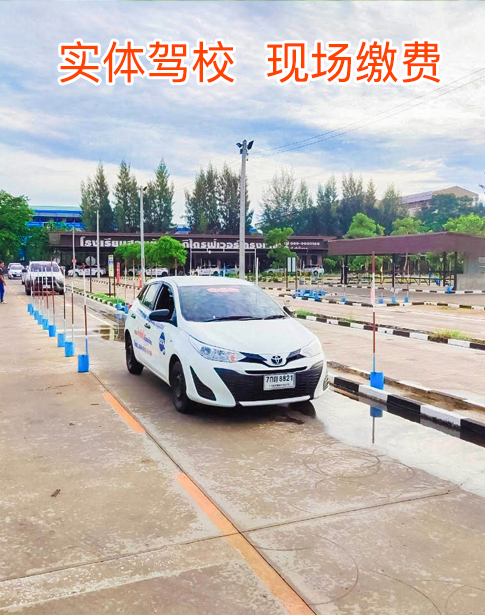
In Thailand, unlike most countries, there is no provision for provisional or probationary drivers. Anyone seeking a driver’s license must pass a driving‑knowledge exam. In Thailand, you can take the test on your own, but authorities generally recommend enrolling in a driving school, as much of the necessary knowledge and experience cannot be acquired quickly through individual effort alone. Driving‑license candidates must spend at least two days at the Department of Transportation undergoing training and testing. Day 1: After completing all preparations, trainees must schedule a visual and reaction‑performance assessment, as well as a four‑hour training course on traffic laws, road sign recognition, and defensive and safe driving practices at the Department of Transportation office. Upon completion of the course, candidates are required to take a written examination. The written exam is administered via a computer-based system and can be taken in Thai, English, Japanese, and Chinese. Except for the Department of Land Transport in Bangkok, other locations may not accept languages other than Thai. After passing the written exam, you can schedule your road test. The road test must be completed within 90 days of passing the written exam; otherwise, it will be considered a forfeit. Day 2: Candidates take the practical exam, which typically consists of three stages.Depending on the venue, car rentals are very affordable. 1. Drive straight forward and backward. 2. Perform the parking maneuver and complete one lap around the course, pulling over with the vehicle no more than 25 centimeters from the curb. 3. Park on a slope and start off from a standstill. After passing the exam, students return to the office, pay the fee, and may then collect their temporary driver’s license. If a candidate has failed all examination subjects, they may retake the failed subjects upon receiving the notification. The retake will be scheduled three days after the results are released, and all examinations must be completed within 90 days.